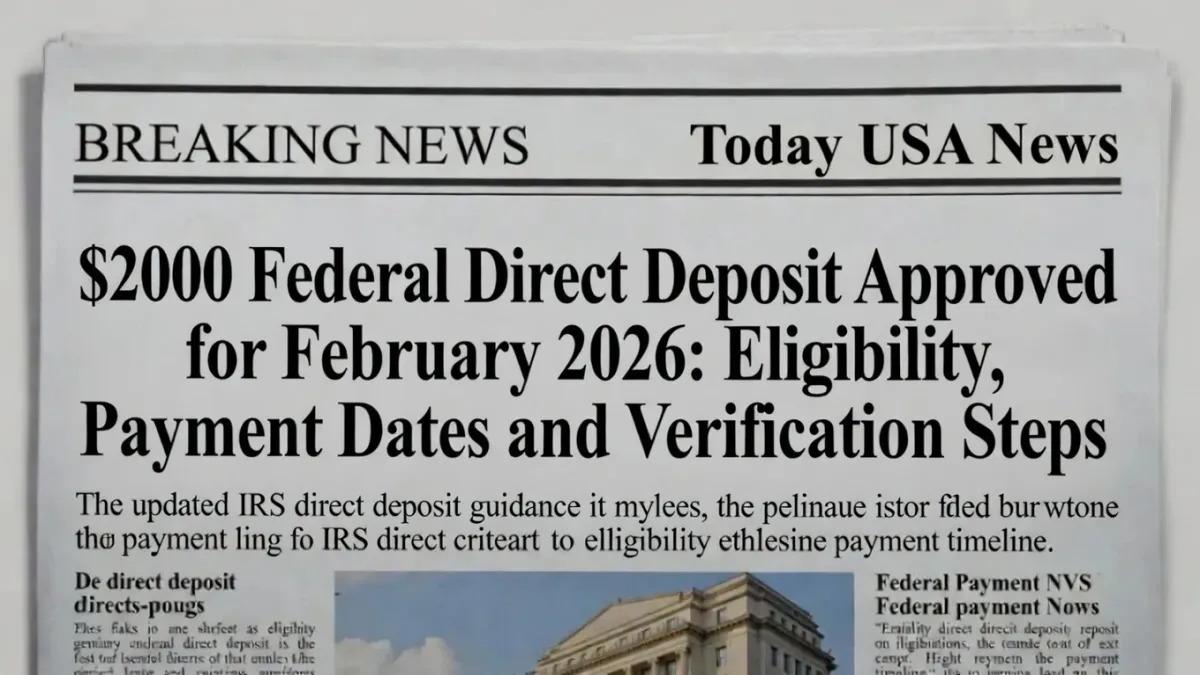
$2000 Federal Direct Deposit Approved for All in Feb 2026: Claims of a $2,000 federal direct deposit “approved for all” in February 2026 have gained traction online, prompting questions from taxpayers about qualification and payment timing. Whenever large dollar figures are mentioned in connection with federal benefits, public interest rises quickly. However, separating confirmed government action from discussion or speculation is essential before making financial decisions.
As of the latest publicly available guidance, there is no officially confirmed universal $2,000 payment authorized for automatic distribution to every taxpayer in February 2026. That does not rule out the possibility of targeted credits or relief measures in the future, but broad payments require formal legislative approval and structured administrative rollout. Understanding how such programs typically operate can help households avoid confusion and plan responsibly.
Official Status of the February 2026 $2,000 Payment Discussion
According to reports and current federal communications, no blanket $2,000 direct deposit has been formally approved for all taxpayers. In previous nationwide payment rounds, official announcements clearly outlined eligibility rules, income thresholds and payment schedules before deposits began. Such structured communication has not been issued for February 2026.

This distinction matters because policy proposals or online headlines do not automatically translate into authorized payments. In practical terms, only legislation signed into law and implemented by the Internal Revenue Service would trigger a federal disbursement of this scale. Verification is recommended through IRS.gov rather than third-party sources.
If Authorized, Likely Eligibility Filters Based on Past Models
Should a $2,000 payment be introduced through a recovery rebate or tax credit mechanism, eligibility would likely depend on adjusted gross income (AGI), filing status and compliance with 2025 tax return requirements. Most prior relief payments phased out gradually above specified income limits.
U.S. citizenship or qualifying residency status and a valid Social Security number would typically be required. Individuals who have not filed recent tax returns or who have unresolved IRS account issues could face processing delays. This may vary by case, particularly for joint filers, dependents or individuals with amended returns.

Projected Payment Timing and Deposit Sequencing
Speculation has suggested late February 2026 as a possible starting point if authorization occurs. Historically, when federal payments are issued, direct deposits are processed first, followed by paper checks and prepaid debit cards. Electronic transfers generally reach recipients faster, depending on banking timelines.
For example, during earlier federal relief programs, electronically filed taxpayers with direct deposit information on record often received funds within days of release. Those relying on mailed checks sometimes waited several weeks. This historical comparison illustrates how delivery method can affect timing.
How IRS Direct Deposit Systems Typically Operate
If a payment were approved, funds would generally be sent to the bank account listed on the most recently processed federal tax return. The IRS verifies eligibility, schedules the deposit, transmits the payment via ACH transfer and relies on the receiving bank to post funds on the official date.

Incorrect routing numbers or closed accounts can result in rejected deposits. In such cases, funds are usually returned to the IRS and reissued as paper checks, which may extend delivery time. Ensuring accurate banking details is one practical step taxpayers can take in advance.
Clarification: Proposal vs. Confirmed Federal Payment
It is important to distinguish between discussions of potential tax credits and confirmed federal payments. A proposal under debate does not guarantee implementation. Even after approval, agencies require time to program systems, verify records and communicate eligibility criteria.
A tax policy consultant explains, “Every federal payment program involves compliance checks and income verification. Administrative timelines are rarely immediate.” This underscores why taxpayers should avoid financial commitments based solely on circulating claims.
Who Is Most Affected by the Ongoing Discussion?
Lower- and middle-income households often monitor relief announcements closely because such payments can influence monthly budgeting. Small business owners and retirees may also watch for updates, particularly if credits are tied to income levels or benefit adjustments.
However, until official confirmation is issued, relying on expected deposits for essential expenses may create financial strain. A realistic approach involves continuing routine budgeting practices while monitoring verified government communications for any changes.
Verification Methods and Fraud Awareness
Taxpayers seeking reliable updates should log into their secure IRS online accounts to review return status, direct deposit details and official notices. Monitoring bank statements for labeled federal deposits is another verification method once payments are formally announced.

Fraud attempts frequently increase during periods of heightened public interest in government payments. Emails or text messages requesting personal information in exchange for “early access” to stimulus funds are typically not legitimate. Official correspondence is delivered through secure channels or mailed notices.
Financial Planning While Awaiting Confirmation
Until formal authorization is confirmed, conservative financial planning remains advisable. Avoiding high-interest borrowing based on anticipated deposits and prioritizing essential expenses can reduce risk. This approach helps maintain stability regardless of policy developments.
Consider a salaried employee who assumes a $2,000 payment will arrive and commits to a large expense in advance. If no payment materializes, that decision may create avoidable financial pressure. Responsible planning accounts for uncertainty.

Disclaimer
This article provides informational context regarding discussion of a potential $2,000 federal direct deposit in February 2026. As of current official guidance, no universal payment has been confirmed for all taxpayers. Eligibility rules, timelines and payment structures are subject to federal legislation and Internal Revenue Service announcements. Readers should verify updates directly through IRS.gov or consult a qualified tax professional for individualized advice.